How To Build A High Performing Sales Team in 2027

Seven Things to Leave Behind in 2026
Before setting bigger revenue targets, increasing headcount or investing in new technology, take a closer look at the habits, assumptions and practices that could be holding your commercial team back.
As we approach the end of 2026, many business leaders will be finalising their growth strategies, revenue targets and commercial plans for the year ahead.
For some, 2026 will have been a successful year. For others, performance may have fallen short of expectations.
But regardless of how the year has gone, there is one question I believe every commercial leader should be asking:
What are we going to do differently in 2027 to achieve better results?
Improving sales team performance starts with understanding what drives revenue and identifying where the greatest opportunities for improvement exist. A high-performing sales team requires a credible revenue plan, effective sales processes, alignment between sales and marketing, strong leadership, continuous development and a proactive approach to talent.
Increasing revenue targets, recruiting more salespeople and investing in new technology may all form part of the answer. But building a high-performing sales team requires more than simply doing more of what you’ve always done.
And importantly, things don’t have to be broken for there to be opportunities to improve them.
Here are seven things I believe commercial leaders should consider leaving behind in 2026 if they want to build a more effective, productive and high-performing sales team in 2027.
1. Setting ambitious revenue targets without a credible plan to achieve them
Leave behind: Revenue ambition without commercial substance.
It’s relatively easy to set a revenue growth target of 15%, 20% or even 30%. Establishing how the business will actually achieve it is considerably more challenging.
Simply increasing the annual target and dividing it between the sales team isn’t a growth strategy.
A credible commercial plan should work backwards from the desired revenue outcome, taking into consideration:
- The volume and value of qualified opportunities required.
- Existing pipeline and historical conversion rates.
- Average deal values and sales cycle lengths.
- Revenue opportunities within existing customer accounts.
- Sales team productivity, capability and capacity.
- The contribution required from marketing and demand generation.
For example, if a business wants to generate an additional £1 million in new business revenue, with an average deal value of £50,000 and a qualified opportunity conversion rate of 25%, it would need approximately 80 additional qualified opportunities, assuming those metrics remain consistent.
Where will those opportunities come from? Does the business have the resources to generate them? And does the sales team have the capability and capacity to convert them within the required timeframe?
These are the conversations that should underpin revenue planning.
Take into 2027: A commercially grounded growth plan that connects revenue ambition with the activities, capabilities and resources required to deliver it.
Ask yourself: What is materially different about our commercial operation in 2027 that will enable us to achieve materially different results?
2. Assuming more salespeople automatically means more revenue
Leave behind: Headcount as the default solution to a revenue challenge.
When sales performance falls behind expectations, increasing headcount is often one of the first options considered.
Sometimes that’s absolutely the right decision.
If the pipeline is healthy, conversion is strong and the existing team simply cannot capitalise on all the available opportunities, additional salespeople can be an excellent investment.
But if the underlying challenge is inconsistent conversion, insufficient demand, ineffective processes or a lack of leadership capability, increasing headcount may simply make the problem more expensive.
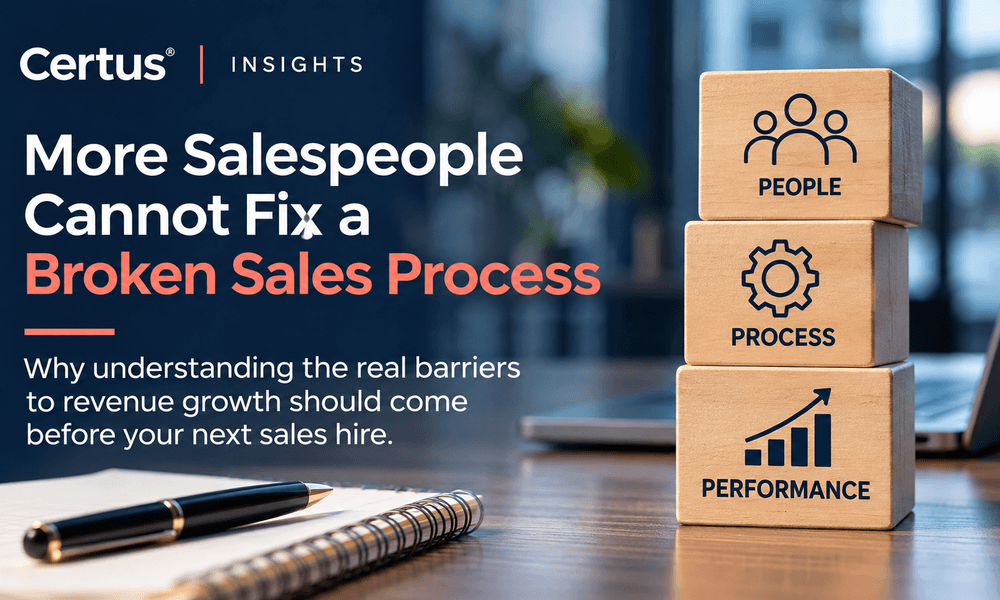
We explored this in our recent Certus Insights article, More Salespeople Cannot Fix a Broken Sales Process, where we discussed the importance of distinguishing between capacity, capability and process before making recruitment decisions.
Sometimes the most valuable appointment isn’t another salesperson. It might be a sales enablement specialist, a stronger sales manager or someone capable of improving both commercial execution and team performance.
Equally, the greatest opportunity for growth may lie in improving the productivity of the existing team without increasing headcount at all.
The objective shouldn’t simply be to increase the size of the sales team. It should be to increase its effectiveness.
Take into 2027: Recruitment decisions based on a clear understanding of the commercial challenge and the return the business expects from each appointment.
Ask yourself: Would another salesperson deliver a greater return than improving the effectiveness of the team we already have?
3. Allowing sales and marketing to operate in silos
Leave behind: Separate departmental objectives without shared commercial accountability.
Marketing celebrates an increase in lead generation. Sales complains about lead quality. Marketing questions how effectively leads are being followed up. Sales argues that it needs more opportunities.
It’s a familiar scenario.
Both departments may be working hard and achieving their individual objectives, yet the business as a whole may still be falling short of its revenue ambitions.
High-performing commercial teams recognise that sales and marketing are not independent functions. They are interconnected parts of the same revenue-generating operation.
That means establishing alignment around:
- Ideal customer profiles and target markets.
- Customer challenges, messaging and proposition.
- What constitutes a genuinely qualified opportunity.
- Lead handover and follow-up expectations.
- Conversion rates throughout the customer journey.
- Shared pipeline and revenue objectives.
Marketing needs visibility of what happens to the opportunities it generates. Equally, sales needs to provide meaningful feedback on customer conversations, objections, buying behaviours and market developments.
The opportunity isn’t simply to generate more leads or increase sales activity. It’s to improve how effectively the two functions work together to generate revenue.
Take into 2027: A shared commercial strategy, supported by common objectives, meaningful data and regular collaboration between sales and marketing.
Ask yourself: Are our sales and marketing teams working towards the same commercial outcomes, or simply achieving their own departmental targets?
4. Accepting established sales processes without challenging their effectiveness
Leave behind: The assumption that established processes are necessarily effective processes.
Businesses evolve. Customer expectations change. Technology develops. Sales teams grow. Markets become more competitive.
Yet many commercial processes remain largely unchanged.
What worked effectively for a team of five may not be appropriate for a team of twenty. Equally, a sales approach that delivered strong results two years ago may not be as effective in today’s market.
And this isn’t necessarily about fixing something that’s broken.
Even successful sales organisations have opportunities to improve qualification, discovery, forecasting, conversion and the overall customer experience.
The end of the year provides an excellent opportunity to review the entire sales process and identify where improvements could be made.
- Where are opportunities consistently stalling?
- Which activities are consuming disproportionate amounts of time?
- Where are salespeople experiencing unnecessary friction?
- Which elements of the process are contributing most effectively to revenue?
AI and automation also present opportunities to improve commercial productivity, whether through research, administration, CRM management, meeting preparation or sales analysis.
However, introducing new technology into an ineffective process doesn’t automatically make that process effective.
Start by understanding what needs to improve, then consider how technology can support it.
Take into 2027: A culture of continuous improvement, supported by effective processes and technology that genuinely enhances commercial productivity.
Ask yourself: If we were designing our sales operation from scratch today, would it look the same as it does now?
5. Managing sales activity rather than developing sales capability
Leave behind: Confusing performance measurement with performance improvement.
There is a fundamental difference between managing salespeople and making salespeople better.
Monitoring calls, meetings, pipeline, forecasts and revenue is important. Commercial leaders need visibility of activity and performance.
But measuring these things doesn’t necessarily improve an individual’s ability to sell.
A salesperson who is struggling to convert opportunities may not need to make more calls or attend more meetings. They may need to improve their discovery skills, qualification, commercial understanding or ability to articulate value.
That requires coaching, development and effective leadership.
High-performing sales managers should understand the individual strengths and development needs of their team members, rather than adopting a one-size-fits-all approach to performance management.
They should also understand what their strongest performers do differently and how those behaviours, skills and approaches can be shared across the wider team.
This is particularly important when recruiting or promoting sales managers.
Being an exceptional salesperson doesn’t automatically make someone an exceptional sales leader. The ability to develop others is a capability in its own right.
When assessing sales leadership talent, businesses should consider not only what an individual has achieved personally, but also their ability to improve the performance of those around them.
Take into 2027: A management culture that places as much emphasis on improving performance as it does on measuring it.
Ask yourself: How much of our sales managers’ time is spent measuring performance, and how much is spent actively improving it?
6. Accepting persistent underperformance as an inevitable part of the sales team
Leave behind: Becoming comfortable with inconsistent performance.
Almost every sales team has a range of performance levels.
There will be individuals who consistently exceed expectations, those who deliver solid results and those who regularly fall short.
Some variation is entirely natural. But accepting persistent underperformance without understanding or addressing its causes can represent a significant missed commercial opportunity.
Before making decisions about individuals, leaders need to understand why performance varies.
Are territories and opportunities comparable? Have individuals received appropriate training and support? Are expectations realistic? Is the issue one of motivation, management, capability or suitability for the role?
Where development can improve performance, that should be a priority.
But where individuals consistently fall short despite appropriate support, clear expectations and a reasonable opportunity to improve, leaders may need to make more difficult decisions.
Consider a sales team of ten people.
If two individuals are each generating £200,000 in annual revenue, while the average of the middle-performing group is £500,000, bringing those two individuals up to that level could generate an additional £600,000 in annual revenue, all other things being equal.
That’s a hypothetical example, but it illustrates an important principle.
One of the biggest opportunities for revenue growth may already exist within your current headcount.
In January, we’ll explore this in more detail through the 20:60:20 sales performance framework, looking at how commercial leaders can better understand performance distribution, develop their existing teams and make more informed talent decisions.
Take into 2027: A proactive approach to understanding, developing and improving individual and collective sales performance.
Ask yourself: What would the commercial impact be if our lowest-performing salespeople performed at the level of our average performers?
7. Recruiting reactively rather than building a strategic talent plan
Leave behind: Allowing vacancies to determine your talent strategy.
For many businesses, recruitment is triggered by an event.
Someone resigns. Revenue falls behind target. A new customer creates an immediate requirement. A sales leader identifies a gap in the team.
The business then enters the market, often under considerable pressure to make an appointment quickly.
Whilst some recruitment needs will inevitably be reactive, a more strategic approach starts with understanding the capabilities the business will require to achieve its future objectives.
- What skills will become increasingly important over the next 12 months?
- Where are the gaps within the existing team?
- Does the business have the leadership capability to support its growth ambitions?
- Are there individuals who could be developed internally?
- Which future appointments could have the greatest commercial impact?
And when recruitment is required, is the business simply replacing what it previously had, or recruiting what it needs for the next stage of growth?
In our earlier Certus Insights article, Five Hiring Decisions That Set Your Next Salesperson Up for Success, we explored how decisions made before recruitment even begins can have a significant impact on the success of an appointment.
The strongest recruitment strategies are not simply about filling vacancies. They are about building the commercial capabilities a business needs to achieve its objectives.
That doesn’t necessarily mean recruiting immediately. It means being prepared to act when the time is right.
Take into 2027: A forward-looking talent strategy that connects recruitment, leadership development and team capability with the wider commercial growth plan.
Ask yourself: Do we have a commercial talent strategy for 2027, or will our recruitment decisions be determined by events as they happen?
Better results require more than bigger targets
Building a high-performing sales team isn’t necessarily about making wholesale changes.
For some businesses, the biggest opportunity will be improving sales and marketing alignment. For others, it will be developing leadership capability, optimising processes, addressing underperformance or making more informed recruitment decisions.
As you prepare your commercial plans for 2027, consider reviewing seven fundamental areas:
- Revenue planning and commercial objectives.
- Sales team capacity, capability and productivity.
- Sales and marketing alignment.
- Sales processes, systems and technology.
- Sales leadership, coaching and development.
- Individual and collective sales performance.
- Strategic recruitment and talent planning.
The important thing is to understand where the greatest opportunities exist within your own commercial operation and establish clear priorities for addressing them.
And don’t assume that because your business has performed well in 2026, there isn’t room for improvement.
Some of the most effective commercial leaders are those who continually challenge what is already working, looking for opportunities to make it work even better.
As a specialist Go-to-Market recruitment partner, we believe our role extends beyond helping businesses identify and appoint talented individuals.
It’s about understanding what a business wants to achieve, identifying the capabilities it needs and helping it make better-informed decisions about its people.
Sometimes that means increasing headcount. Sometimes it means strengthening leadership or introducing new capabilities. And sometimes it means recognising that recruitment isn’t the immediate priority.
The objective is not simply to build a bigger sales team. It’s to build a better-performing one.
Is your sales team ready for 2027?
To complement this article, we’ve developed the 2027 Sales Team Readiness Toolkit — a practical resource designed to help founders, CEOs and commercial leaders review their sales operations and establish clear priorities for the year ahead.
The toolkit includes:
- A 21-question Sales Team Readiness Scorecard covering the seven commercial areas explored in this article.
- A prioritisation framework to identify your biggest opportunities for improvement.
- A 90-day action plan to turn your findings into measurable objectives for Q1 2027.
Whether you’re planning significant growth, reviewing an established sales operation or looking to improve the performance of your existing team, it’s a useful starting point for your 2027 commercial planning.
Download your free 2027 Sales Team Readiness Toolkit
About the author — Greg Clay
Group Managing Director | Certus Recruitment Group
Having spent more than 20 years in senior Go-to-Market leadership and Managing Director roles, Greg understands first-hand the challenges of driving revenue growth, developing commercial strategies and building high-performing teams.
With over 25 years of commercial experience across SaaS, technology and professional services, he has worked with businesses navigating growth, expansion and transformation in both domestic and international markets.
Today, Greg applies that experience to specialist Go-to-Market recruitment, bringing the perspective of someone who has not only recruited commercial teams but also led them and been accountable for their performance.
He believes successful recruitment starts with understanding what a business needs to achieve, not simply who it wants to hire.
Certus Recruitment Group
Specialists in Go-to-Market and Technology Recruitment | Cambridge · Austin · Melbourne
What’s next for your team?
Got a plan in mind, a few ideas or just a question? Greg would be happy to talk it through.
Contact Greg directly at greg.clay@certusrecruitment.com.