
Fractional leadership gives businesses access to experienced senior leaders without requiring a full-time permanent appointment. But the term can be misleading.
A fractional leader might provide strategic direction and senior oversight for a few days each month. They might work alongside the existing team to turn strategy into execution. Or they might enter the business to build or transform a function, establish the foundations and eventually hand responsibility to permanent leadership.
The right model depends on the challenge, the stage of the business and the capability already in place.
For technology businesses, this can be particularly valuable during periods of change — moving beyond Founder-Led Sales, navigating 0→1 or 1→10 growth, entering a new market, building a new function, preparing to scale or bridging a leadership gap.
Fractional doesn't describe the job. It describes how you access the expertise.

The Gap Between Founder-Led and Fully Scaled
As technology businesses move from 0→1 into 1→10, the challenge changes. Founder knowledge needs to become repeatable process, individual success needs to become organisational capability, and the business needs experience it may not yet be ready to hire permanently.
Fractional leadership can bring in experience from the stage you're entering — without building tomorrow's permanent leadership team too early.
Leadership Needs Change as the Business Scales
0 → 1: Prove It
At the earliest stage, the priority is proving that the business can solve a meaningful problem for a defined market. Founders are typically close to the customer, heavily involved in sales and making decisions quickly.
The leadership requirement is often about finding Product-Market Fit, defining the ICP, sharpening the proposition and discovering what actually works.
1 → 10: Make It Repeatable
Once there's evidence of demand, the challenge changes. What worked through founder relationships, individual knowledge and instinct needs to become something other people can execute.
This is where businesses start building the GTM playbook, repeatable sales motion, qualification, pipeline management, forecasting, RevOps and clearer functional ownership.
Fractional leadership can be particularly valuable here because the business gains experience from someone who has already navigated this transition without necessarily making a permanent executive hire too early.
10 → 100: Build for Scale
As the business grows, the requirement shifts again. Processes need to withstand greater volume, functions become more specialised and leadership becomes increasingly about organisational design, performance, predictability and efficiency.
At this point, the question may be whether fractional expertise is still appropriate or whether the business is ready for permanent leadership and a more established management structure.

From Founder Knowledge to a Repeatable GTM Model
Early growth can depend heavily on founder instinct, relationships and deep product knowledge. Scaling requires that knowledge to become something the wider team can understand, measure and repeat.
The goal isn't simply to hire more salespeople. It's to build a GTM model they can succeed within.
What Can a Fractional Leader Actually Do?
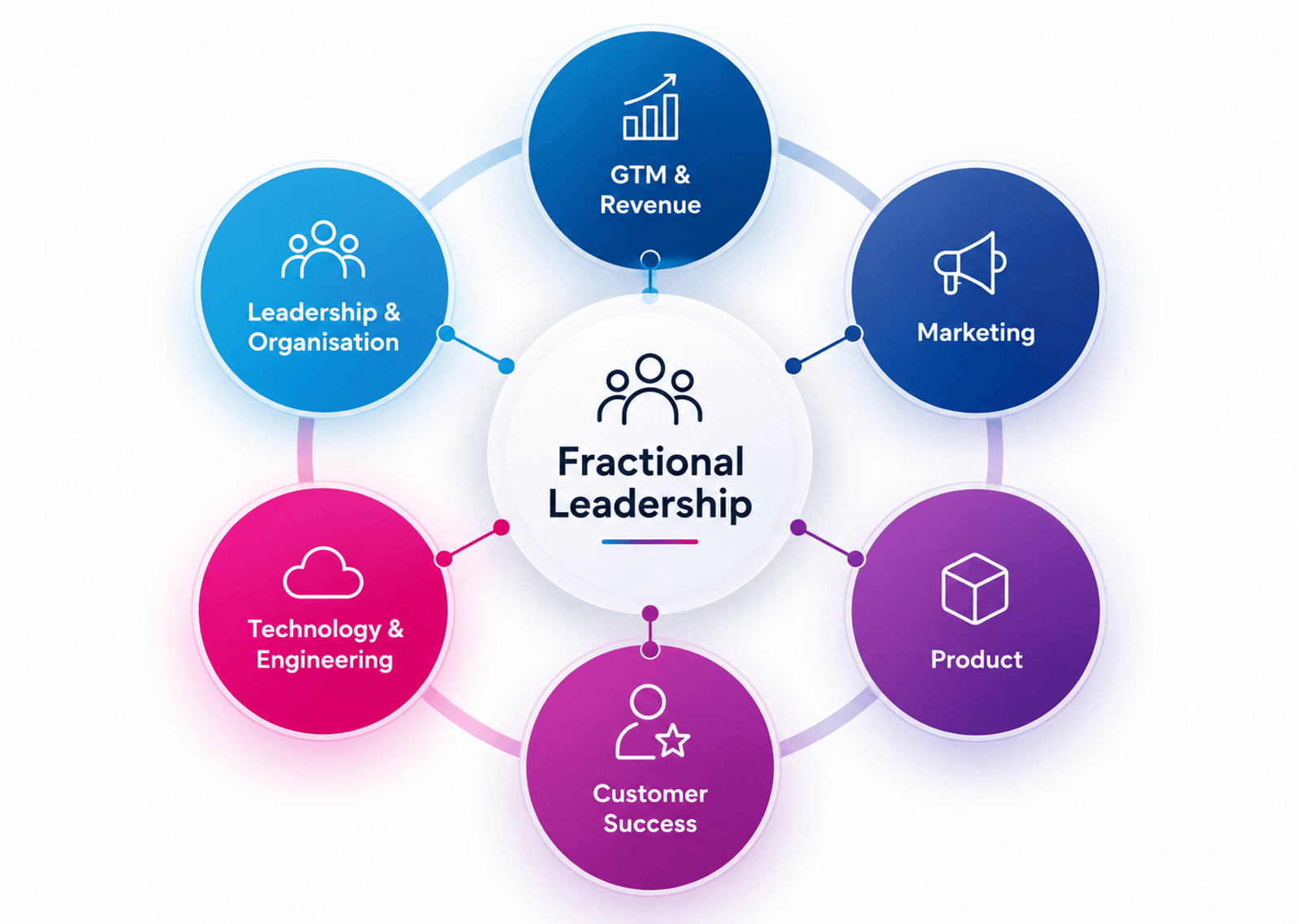
Fractional leadership can solve very different problems depending on the stage of the business, the capability already in place and the outcome required. The role might be primarily strategic, combine strategy with execution, or involve building and embedding an entire function.
GTM & Revenue
Define the ICP, positioning and GTM motion; strengthen pipeline, qualification and forecasting; establish RevOps and sales methodology; and improve commercial performance.
Marketing
Develop positioning, demand generation and brand strategy; strengthen alignment with Sales; establish the right operating model and build marketing capability.
Product
Shape product strategy and roadmap, strengthen Product-Market Fit, bring customer insight into decision-making and improve alignment between Product, Technology and commercial teams.
Customer Success
Improve onboarding, retention and expansion; develop the customer lifecycle; establish stronger CS processes and metrics; and build a Customer Success model that can scale.
Technology & Engineering
Define technical strategy and architecture, shape the technology roadmap, improve engineering structure and delivery, and establish the foundations for Cloud, Infrastructure, Data and AI capability.
Leadership & Organisation
Build or transform functions, coach existing leaders, define organisational structure and hiring requirements, and prepare the business for permanent leadership when the time is right.
Strategy, Execution — or Both?
Some businesses need an experienced leader to diagnose the problem, set direction and advise the existing team. Others need someone who will also roll up their sleeves and help make it happen.
The right fractional model depends less on the job title and more on the outcome you need the leader to deliver.
How Involved Should a Fractional Leader Be?
The word fractional describes how you access the expertise — not how involved the leader should be.
The right model depends on what the business needs to achieve, the capability already in place and how much responsibility the fractional leader needs to take.
Strategic
The leader provides senior expertise, challenge and direction without becoming heavily involved in day-to-day execution.
This might include diagnosing problems, defining strategy, setting priorities, advising founders or leadership teams and providing ongoing senior oversight.
Strategic + Execution
The leader helps determine what needs to happen and then works alongside the business to make it happen.
They might develop the strategy, establish processes and operating rhythms, coach the team, implement new ways of working and take direct responsibility for key initiatives.
Build → Embed → Handover
The leader takes responsibility for establishing or transforming a capability within the business.
They build the foundations, embed the processes and ways of working, develop or recruit the team and ultimately transition responsibility to permanent leadership.
The most important question isn't how many days a week you need someone. It's what you need them to achieve.

Flexible Expertise Needs a Flexible Engagement
A fractional leader might be needed for a few days each month, an intensive period of execution or a clearly defined project with a specific outcome.
The engagement model should follow the work — not force the work to fit the commercial model.
How Are Fractional Leaders Engaged?
There is no single commercial model for fractional leadership. The right structure depends on the scope of the work, how much flexibility is required and whether the engagement is based primarily on time, ongoing access or a defined outcome.
Day Rate
A straightforward option when the requirement is flexible or the level of support may change over time. The leader works an agreed number of days, with the business paying for the time used.
This can work particularly well for shorter engagements, intensive periods of activity or where the scope is likely to evolve.
Monthly Retainer
Often used where the business wants consistent access to senior leadership over a longer period. The engagement might provide a defined number of days each month or an agreed level of ongoing involvement.
This creates continuity while retaining considerably more flexibility than a permanent appointment.
Statement of Work / Project-Based
Useful where there is a clearly defined objective or set of deliverables — such as developing a GTM strategy, preparing for international expansion, establishing a new function or delivering a transformation programme.
The engagement can be structured around specific outcomes, milestones and a defined timeframe rather than simply the number of days worked.
Start by defining the outcome, scope and level of involvement required. The commercial structure should then be built around the work.

Not Sure What Kind of Fractional Leadership You Need?
You don't need to arrive with a job title, number of days or engagement model already defined. Tell us what you're trying to achieve, where the business is today and where you need experienced leadership to make a difference.
We'll help you determine the capability, level of involvement and engagement structure that makes sense.