
The Tech Stack Is Only the Starting Point
Two candidates can list exactly the same languages, frameworks and platforms yet have very different experience of using them.
One may have built products from the ground up; another maintained mature systems. One may have worked with millions of users and complex distributed architecture; another may have operated in a smaller, simpler environment. One may have made architectural decisions themselves; another worked within decisions made by others.
That doesn't make one candidate better than the other. It means they're different — and the environment you're hiring them into matters.
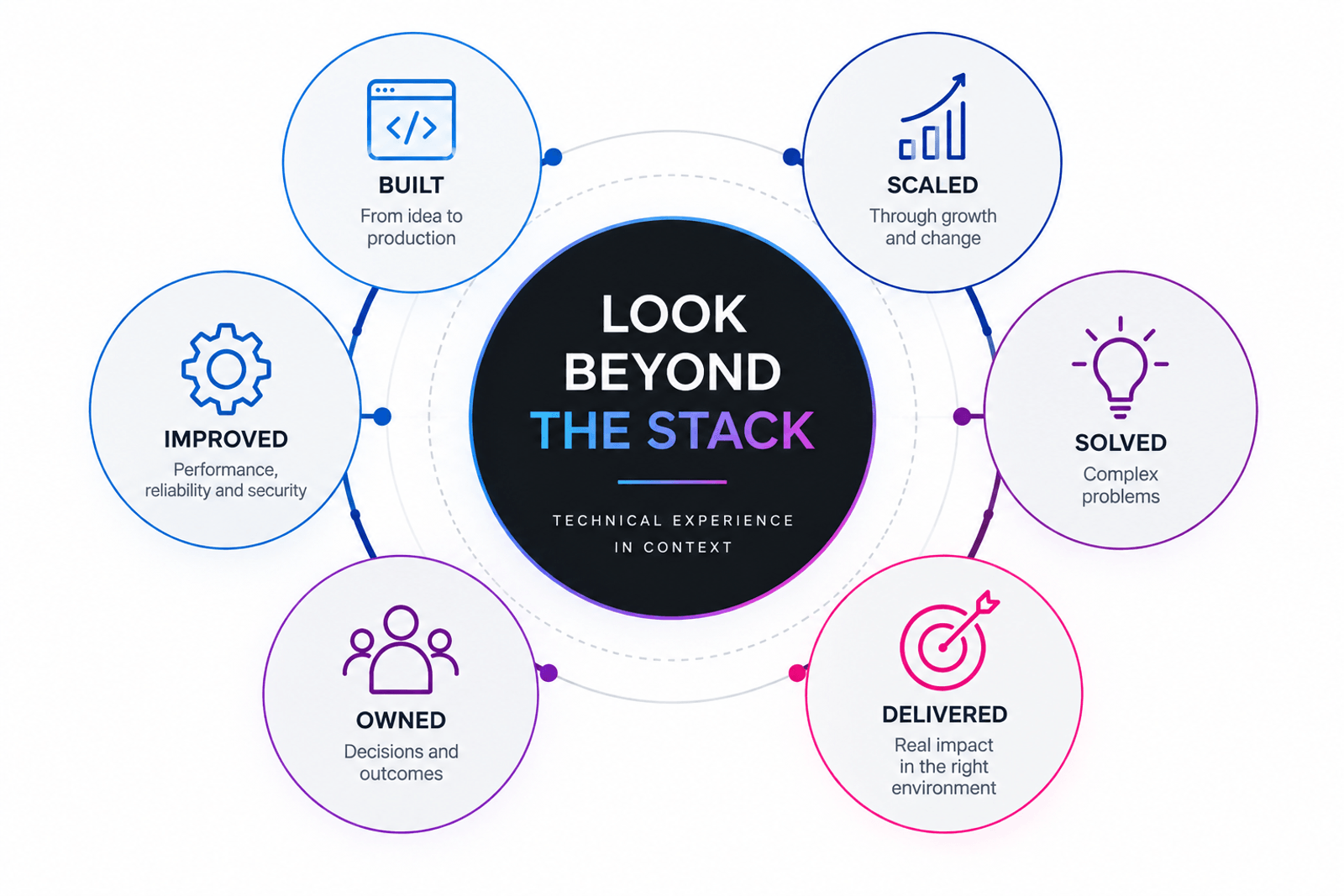
Effective technical hiring means understanding not only what somebody knows, but what they've actually built, the problems they've solved, the complexity they've handled and the level of ownership they've had.
That's where we start when assessing technical fit.

Experience Has Context
A technology on a CV tells you very little about how someone has used it.
The real questions are about scale, complexity, ownership and environment. Did they design it, build it, improve it or simply work alongside it?
Understanding that context is what turns a technical match into a technical fit.
WORK FOR US
What Have They Actually Built?
Job titles and technology lists only tell part of the story. To understand technical fit, you need to look at the environment behind them and the contribution they personally made.
Someone who has built a new product from the ground up may bring very different experience from someone who has modernised a complex legacy platform. An engineer who has helped scale systems through rapid growth may have faced different challenges from someone working within an established enterprise architecture.
We look beyond the stack to understand what candidates have actually delivered — the scale and complexity they've handled, the decisions they've owned, the problems they've solved and the impact their work has had.
That means exploring areas such as greenfield versus legacy, architecture and infrastructure, scalability, reliability, security, performance, technical debt and individual ownership — always in the context of what your business actually needs.
The aim isn't to find someone who's done exactly the same job before. It's to understand whether their experience gives them the foundations to succeed in the environment you're hiring them into.
The Same Engineer Won’t Thrive Everywhere
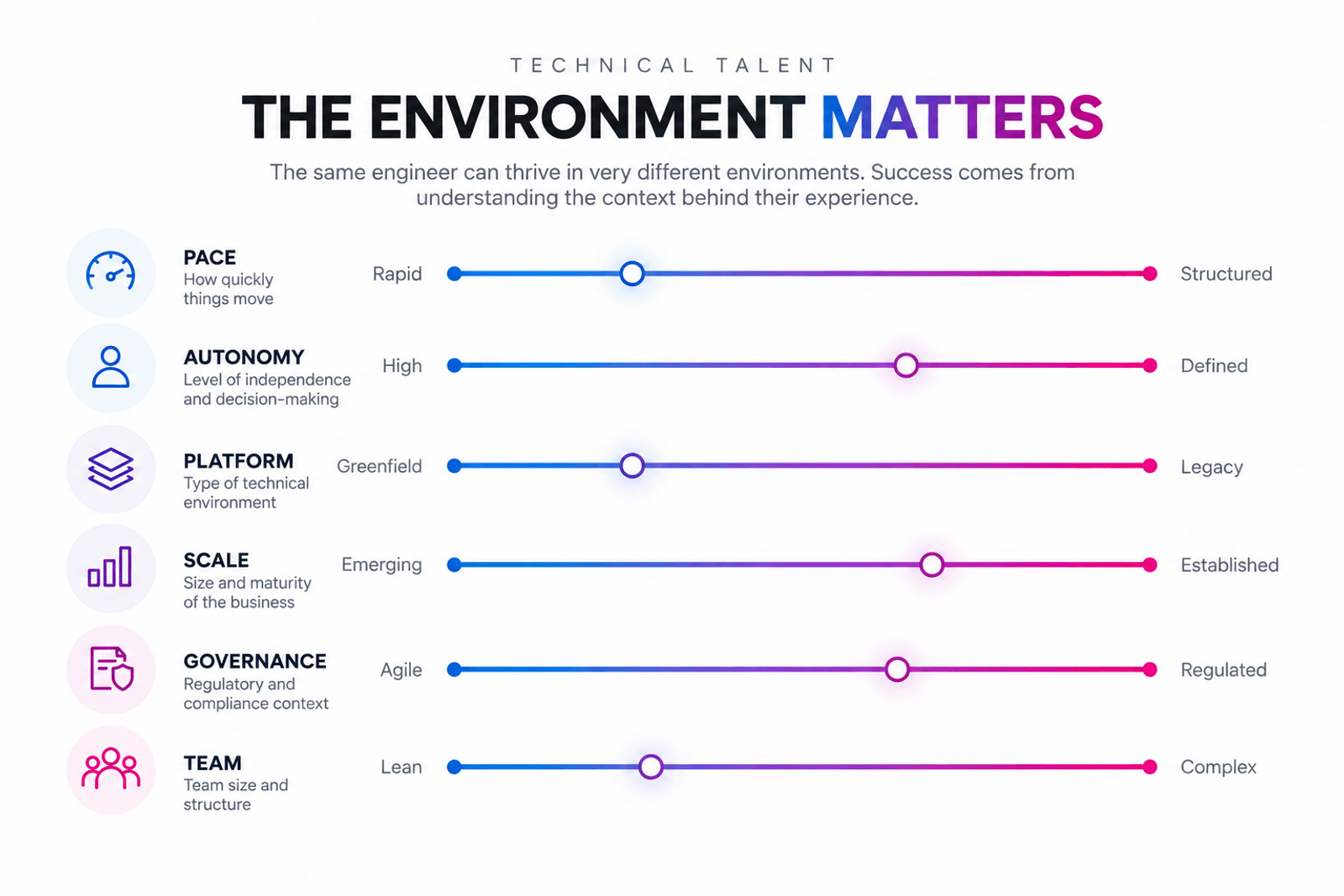
Technical ability doesn't exist in isolation. The environment around an engineer can fundamentally change what success looks like.
Someone accustomed to high autonomy, rapid releases and imperfect information may operate very differently from someone experienced in complex governance, regulated environments or large established engineering teams.
Neither is inherently better. The question is whether the environment in which they've succeeded resembles the environment you're asking them to succeed in next.
Understand the Environment Behind the Experience
Technical experience only becomes meaningful when you understand the environment in which it was gained.
An engineer who has excelled in a small product team with considerable autonomy may be perfect for one business and completely wrong for another. Equally, someone experienced in highly regulated, security-critical or complex enterprise environments may bring disciplines that simply haven't been required elsewhere.
We look at the context surrounding a candidate's experience: business maturity, team structure, pace of delivery, autonomy, governance, regulation, architecture and ways of working.
That might mean understanding whether they've worked in greenfield or legacy environments, helped modernise existing platforms, operated within distributed teams, worked closely with Product, dealt with significant technical debt or delivered where security, resilience and compliance are critical.
It's not about finding an identical environment. It's about understanding which experiences are transferable — and where someone will need to adapt.
Technical Interviews Should Test Evidence, Not Memory
The best technical interview isn't necessarily the one with the hardest questions.
It should uncover how someone thinks, the decisions they've made, the trade-offs they've considered and what they personally contributed to the outcome.
Past projects, real problems and technical decisions often tell you far more about future performance than testing whether someone can recall the right answer under interview conditions.
Great Engineers Don't Work in Isolation
Technical capability matters, but so does the ability to apply it within a team and a wider business.
The strongest technical hires can communicate their thinking, challenge constructively, collaborate with Product and other stakeholders, take ownership and adapt as requirements change.
What that looks like will differ by role. A Principal Engineer may need to influence technical direction across multiple teams. A developer in a small scale-up may need to operate with considerable ambiguity. An infrastructure specialist may need to balance engineering priorities with security, resilience and commercial realities.
That's why our assessment looks at how someone works as well as what they can do — and whether that working style fits the role, team and environment they're joining.