
Look at positioning, demand generation, outbound sales and partnerships.
Don't Start With the Org Chart
One of the easiest mistakes when building a GTM team is to start with job titles.
“We need an SDR.”
“We need a VP Sales.”
“We should probably hire someone in Marketing.”
But the right hire depends on what your business is trying to achieve — and, more importantly, what's currently preventing you from getting there.
If pipeline is the problem, the answer may be Marketing, outbound Sales or Partnerships. If you're generating opportunities but struggling to convert them, you may need very different capability. If customers aren't adopting, renewing or expanding, adding more salespeople won't solve the underlying problem.
Start with the constraint. Then identify the capability needed to solve it. Only then decide who to hire.
That principle should sit at the heart of how you build and scale your GTM team.

Start With the Constraint
Before deciding who to hire, understand what is actually limiting growth. Where the customer journey is breaking down gives you a much better indication of the capability you need than an org chart ever will.
Don't ask which role you should hire next. Ask what's stopping you from growing — and what capability will change it.
Not Enough of the Right Opportunities?
Opportunities Aren't Converting?
Look at sales capability, qualification, process, proposition and enablement.
Customers Aren't Retaining or Growing?
Look at onboarding, Customer Success, product adoption and account development.
Growth Is Getting Harder to Manage?
Look at Revenue Operations, systems, data, processes and leadership.
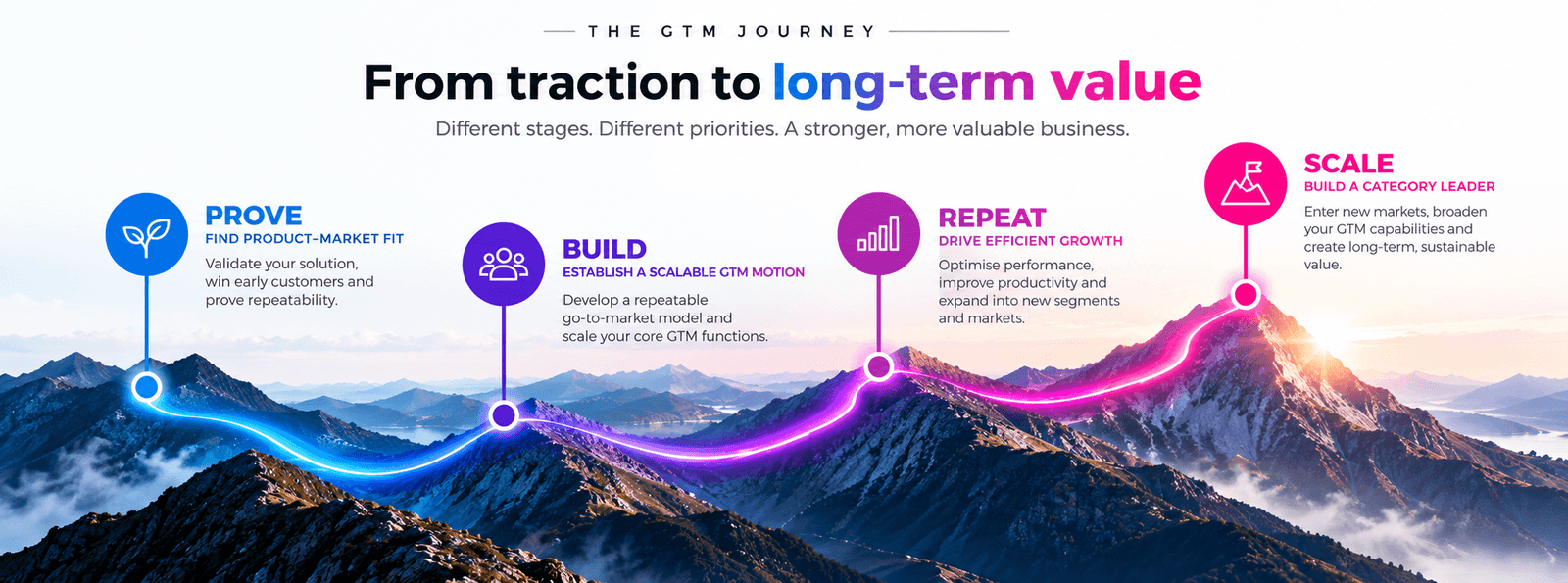
Your Funding Round Doesn't Define Your GTM Team
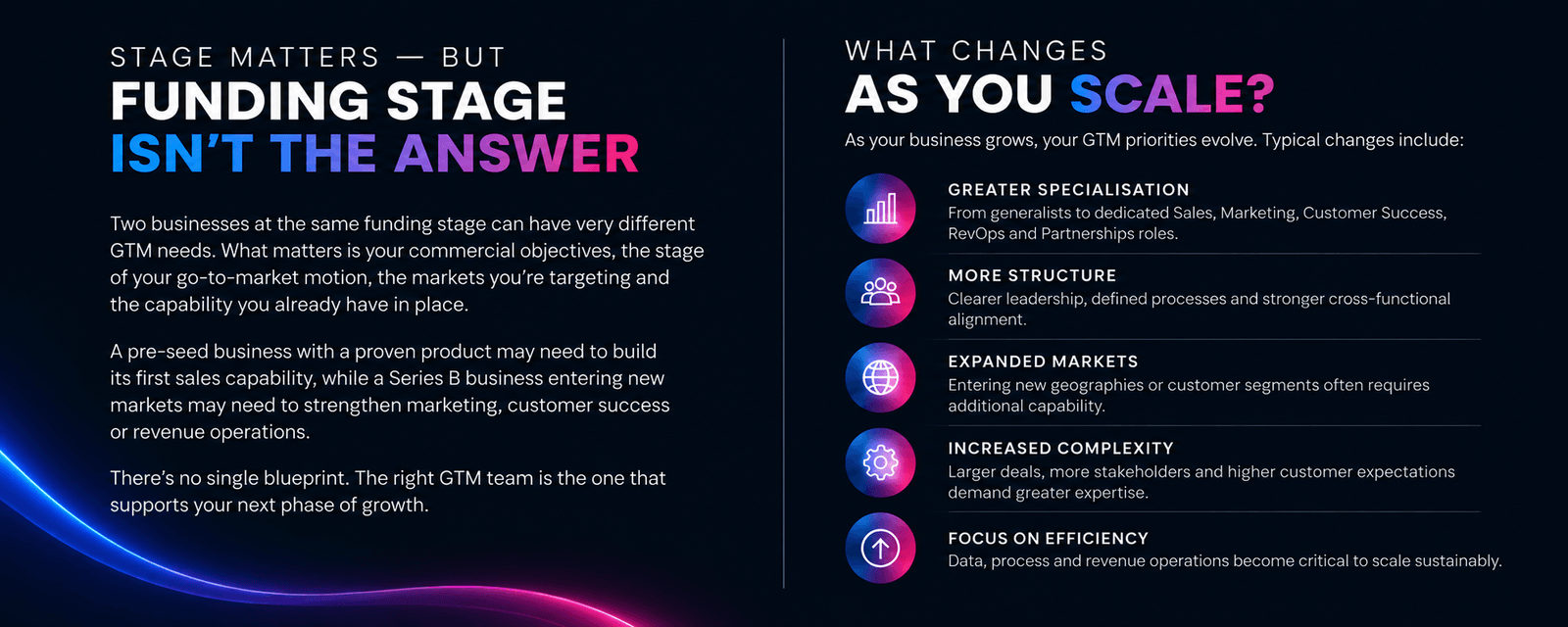
Seed, Series A and Series B are useful descriptions of where a business is financially, but they don't tell you what its GTM organisation should look like.
Two businesses at the same funding stage can have completely different requirements. One may still be proving its ICP and sales motion. Another may already have predictable demand and need to strengthen Marketing, Customer Success or Revenue Operations. A third may be preparing to enter a new market or build an entirely new route to revenue.
Revenue, headcount and funding all provide context, but so do your market, ACV, sales cycle, product complexity, route to market and how much of your commercial motion you've actually proved.
Build the GTM capability your business needs for its next stage of growth — not the team an org chart says you should have.
Build for What Comes Next
The right GTM structure isn't static. What works while you're proving the market will rarely be what you need once growth becomes repeatable, customers become more complex or you begin expanding into new markets.
The strongest GTM teams evolve deliberately — adding specialist capability, leadership and structure when the business is ready to benefit from them.
The goal isn't to build the biggest team. It's to build the right capability at the right time.
Who Should You Hire Next?
There isn't a universal GTM hiring sequence.
Your next hire should address the most important capability gap in the business — not simply be the next box on a conventional organisation chart.
If you have strong inbound demand but insufficient capacity to convert it, another salesperson may make sense. If your sales team is capable but pipeline is inconsistent, the priority could be Marketing or outbound capability. If you're winning customers but struggling with adoption or retention, Customer Success may deliver greater value than adding another AE.
As complexity increases, the answer might be RevOps. If direct sales is working but there are credible alternative routes to market, it could be Partnerships. And if the team has grown beyond the people currently leading it, the requirement may be leadership rather than additional individual contributors.
Sometimes the right answer isn't a permanent hire at all. Fractional leadership can provide experienced capability while you prove the requirement, build the function or prepare for the permanent hire.
The best next hire is the person who solves the problem that matters most now, while helping the business get ready for what comes next.

Build Capability Before Headcount
Scaling a GTM team doesn't mean hiring every function as quickly as possible.
In the early stages, founders may still own Sales. Marketing might be supported by an agency or specialist. Revenue Operations responsibilities may sit across existing leadership. Senior GTM expertise can be introduced fractionally before there's a need for a permanent executive.
As the business grows and the commercial motion becomes more repeatable, those responsibilities can become dedicated roles — and eventually complete functions.
The question isn't whether you have every role. It's whether you have the capabilities the business needs at its current stage — and whether any of them have become important enough to require dedicated ownership.